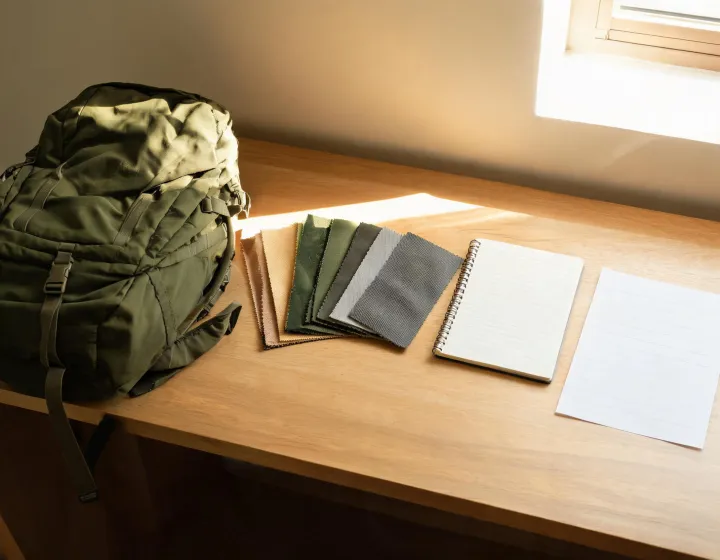
Suppose the schedule is built on the assumption that the raincover ships inside the pack. The quote goes out, pattern work gets planned around a base pocket that already exists in the reference sample, the shipment slot gets booked. Then the pre-production sample arrives and the pocket that stores the cover needs its own pattern and its own station on the line. New paper pattern, second round of samples, re-quote, moved slot. That is the bill for treating raincover included as a checkbox on a category list.
Raincover and backpanel ventilation are two separate acceptance items on a custom hiking backpack, and each one means something only when it is bound to a specific model. Everything I name here comes from one historical source: the Osprey Fall 2024 corporate workbook and the series it documents. That is a named example from a manufacturer's own material, dated 2024, with no bearing on what your factory can build, stock or quote today, and no independent test behind any of it.
What a Bad Raincover Call Costs You
The lesson is not that base pockets are bad. It is that an unwritten stow location becomes a design change at the worst moment, when the base panel, the frame sheet and the seam line all get touched at once. The cover is rarely where the money goes. The real cost is the delivery date you promised a retail buyer, plus the air freight you book when a second sample round pushes production past the vessel you planned on.
A supplier may quote the pocket it already builds unless your sheet says otherwise. If the line sheet says included and stops there, the factory prices its default, and you find out at pre-production which default that was. That is how a missing stow detail turns into a pattern change, not a cover problem.
Raincover Included Means Included On This Model
I checked page 65 of the Osprey Fall 2024 workbook. Under a heading that reads RAINCOVER INCLUDED, the text states the cover is stored in a zippered pocket at the base of the pack, made from bluesign® approved materials, with a DWR treatment made without PFAS. That is the manufacturer's own description of one model in one season.
What it does not tell you: that the same pocket appears on your build, that the fabric is available to your factory, that the finish chemistry is repeatable somewhere else, or that anything is in stock now. So that sentence converts into three questions you put to the supplier in writing. First, attachment and stow: does the cover live in a zippered pocket at the base, in the lid, or in a separate stuff sack, and how does it stay on the pack in wind. Second, coverage: which parts of the pack does the cover enclose, and what does the supplier say it is not meant to handle. A raincover is a cover over a pack, and any claim past that needs its own documentation. Third, the finish: if PFAS-free is part of your requirement, ask for the DWR chemistry in writing, because water repellent on a line sheet does not specify a chemistry.
Turning Ventilated Backpanel Into a Spec Line
The same workbook describes an AirSpeed™ backpanel as tensioned mesh that keeps the weight off your back for ventilated carrying comfort. Read it as design intent, not a measurement. Nothing there gives you a gap, a mesh count or a load figure you could hold a factory to, and that is not a knock on the writing; it is what a design description is for.
Which is why the spec line has to be bound to a model and paired with a check both sides accept: where the backpanel meets the back, whether the mesh is under tension or sagging, how the pack sits when loaded. The tradeoff I would make every time is one line, tied to the model being quoted, that a sample can pass or fail, instead of a string of adjectives such as breathable, ergonomic or airflow-max. Adjectives survive every sample review because nobody can fail them, and a line nobody can fail is not a spec line.
That preference flips the moment the factory hands you a current, dated construction description written for the exact model on the quote, plus a sample you can hold against it. With both in hand you can add specifics, because now there is something to check against and a reason to argue about it.
The Sample Check I Would Run Before Approval
Imagine the sample on the table. Here is the order I would go in, and what counts as a fail. One hand on the base pocket: open, close, open again with the pack empty and then loaded. If the zipper needs two hands, or the cover has to be folded a particular way before the pocket shuts, that is a fail on retrieval. Retrieval is the whole reason the pocket exists.
Next, load the pack to the weight you expect it to carry on a day hike and put it on. I want to see where the mesh panel actually touches, whether across the shoulder blades, down the spine or at the lumbar, and whether the mesh is tensioned or flattened against the load. If the contact patch matches the construction description, it passes. If the load sags into the mesh, the ventilation line on your spec sheet is decorative. Then the cover, with the pack loaded: have the factory fit it in front of you and state which parts it covers and how it stays put. If they cannot demonstrate it on a loaded pack, the cover is not specified yet, whatever the line sheet says.
I have not run this sequence on a supplier sample for this program, so there are no results, no timings and no pass rates to report. It is the check I would write into the approval form before the first sample ships, and the point of writing it first is that a factory can see what it is being asked for.
Why the Pocket Sits at the Base
I found both of the statements I care about on the same page of that workbook. The base pocket keeps the cover out of the main compartment: you are not unpacking a loaded pack to reach it, and the load you packed does not shift when the weather turns. The other line says clean, uncluttered designs are easy to use and understand, which reads as a layout claim more than a style one: fewer entry points, fewer decisions on the trail.
In a custom spec that becomes a retrieval condition rather than a color or shape preference. Where does the cover live, can it be reached with one hand and without emptying the pack, and does stowing it cost main-compartment volume. State the condition, then let the factory propose the construction. Where this stops: it is one named historical series' arrangement. A different pack may keep the cover in the lid or ship it loose, so base-pocket stowage is a decision you ask for, not a category default you assume.
What Would Overturn This Conclusion
One condition would let you drop the split acceptance and go back to a single line item: documentation. A written construction description dated for the model on the current quote, naming the raincover attachment and coverage extent and the backpanel construction, plus a written statement of the DWR chemistry if that matters to your buyer. With that and a production-representative sample checked against the same document, the careful split approach shrinks into a document comparison, which is faster and cheaper.
What does not overturn it is a brochure, a photo of someone else's pack, or a verbal 'same as that one' in a chat thread. Those are how a late pattern change starts.
Who Should Skip This Spec Work
If you buy catalog stock, or run a small labeling job, or the supplier has already handed you dated written specifications for the exact model, skip this. Two acceptance items and a documented sample check are overkill on a pack you did not design.
Keep it if you are sampling to your own spec sheet, specifying a backpanel construction, or asking for a raincover that is not the supplier's default. Then cut the sheet to two lines, one for how the cover attaches and what it covers, one for how the backpanel contact area gets checked on a sample, and get both confirmed in writing before tooling starts. One confirmable line beats a page of praise, which is the same trade as the backpanel, just quieter.

Leave a procurement question